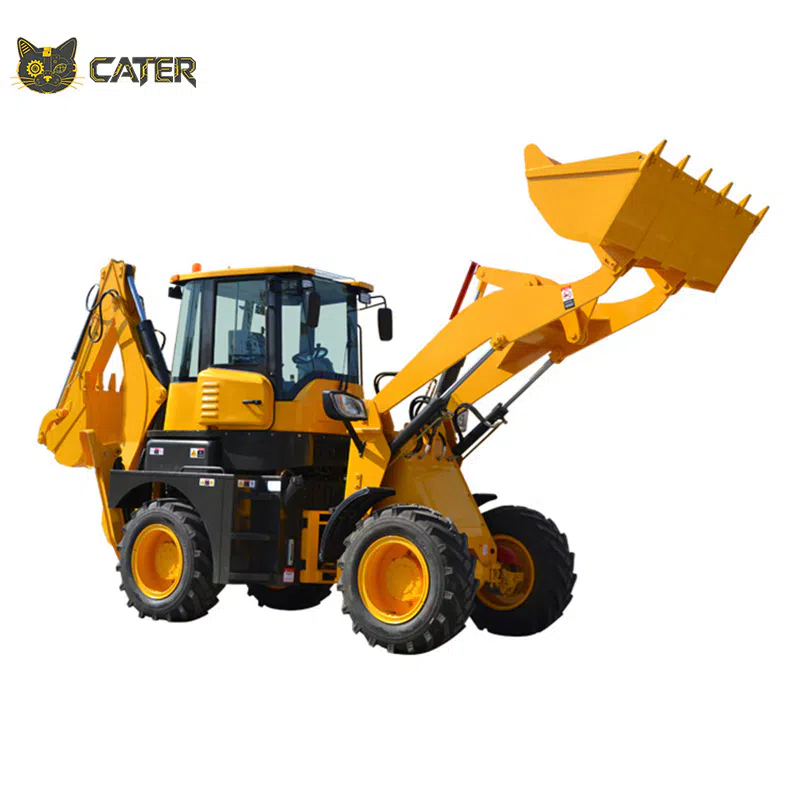
A backhoe loader earns its place on work that mixes digging, loading and reinstatement inside the same shift: municipal and utility repairs, road construction and infrastructure packages, land preparation, farm drainage and landscaping. The front bucket loads, spreads and backfills while the rear digging arm opens trenches, pits and footings. The machine discussed here sits in the heavier end of the wheel backhoe loader class, so every workflow note carries the same site check: dimensions, access and duty have to be measured against the actual job. This article covers how those workflows usually run, how to judge between one dual-purpose machine and a split fleet, what to record when assessing a job, and where the machine is the wrong tool.
Why the backhoe loader still earns its place
The case rests on task variety rather than output on any single operation. Equipment World's Quick Data: Top-Selling Backhoes of 2025–2026 (published 15 July 2026, updated 21 July 2026) reports that backhoe loaders accounted for 1.4% of new financed machines in the United States, with 2,058 new financed units between 1 May 2025 and 30 April 2026, 1.8% below the 2,095 units in the prior comparable period. Financed used backhoes reached 2,768 units, down 6.1% from 2,949.
Three boundaries keep those numbers in proportion. They cover financed transactions in one country, so cash purchases and every market outside the United States are absent, and they are not a global demand index or a forecast. The comparison periods also run roughly a year apart. And a share of new financed machines says nothing about what suits a particular site. What the article does support is a trend: backhoes are still valued for their versatility while compact machines compete for smaller work. The machine's place therefore depends on how many tasks it can absorb in a week, not on beating a specialist at any one of them.
Municipal, road and infrastructure work: dig, load and reinstate in one sequence
A typical municipal or utility job is small, disruptive and tightly time-boxed. A water crew cuts a trench in a residential street, replaces a section of main, backfills, compacts and returns the surface to traffic. Road construction and infrastructure packages repeat the same rhythm: drainage and service runs, footpaths, verges and small structures. One machine can open the excavation, stockpile spoil, load surplus into a truck and place backfill, but the operator still repositions the machine, levels and stabilises it, and changes attachments when the task changes. What a dual-purpose unit may reduce is the number of separate machines and their movements on and off site, not the individual steps of the work.
Planning that sequence is mostly about the site, not the machine. Services are located and marked before the first bucket enters the ground, with hand work or vacuum excavation reserved for the last stretch around live pipes and cables. Spoil is stockpiled clear of access, drainage and fire routes. Backfill goes in layers with compaction between them, and reinstatement material is staged within reach of the front bucket. Access decides most street work: gate widths, parked cars, overhead cables and turning room all have to be measured against the listed dimensions of the machine you intend to use. Traffic management on a live carriageway is a separate discipline that no loader configuration changes.
Where the combination helps and where it does not
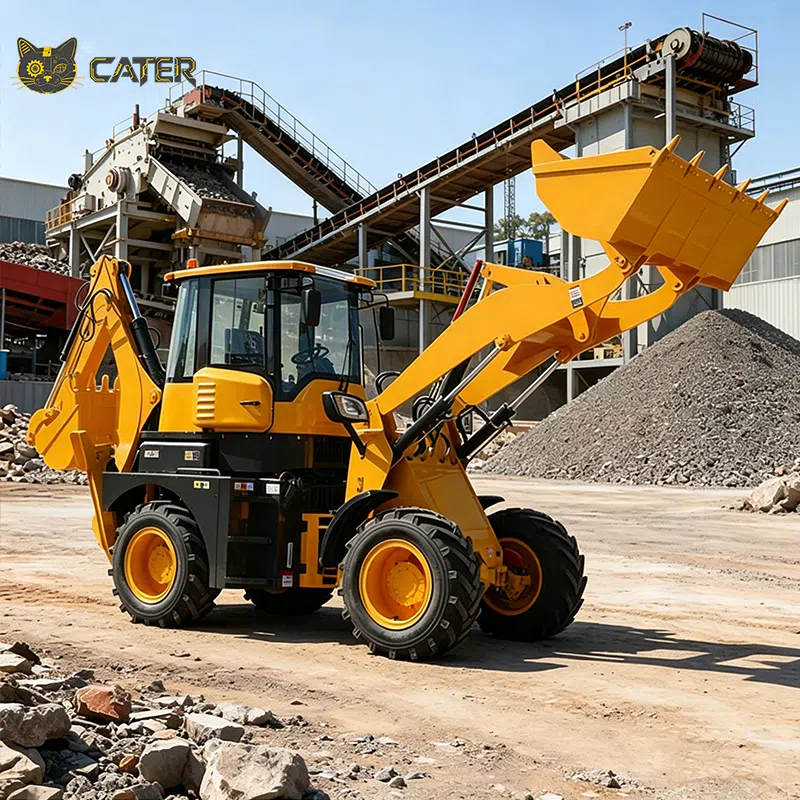
The combination helps on service pits, footings, culverts, sign and post holes, short drainage runs and the handling that sits between them, with reinstatement finished by the same machine. It is also where the limits show. Long, continuous trenching or continuous truck loading is normally better served by dedicated equipment, and the right answer depends on measured duty per shift — dig depth, trench length, haul distance and cycle time — rather than on a general assumption either way.
Farm and smallholding workflows
On a farm, the same machine answers questions that arrive without notice. Field drainage and ditch cleaning call for the rear arm; yard repair, gate and fence post holes, and levelling follow seasonally. The front bucket moves gravel, soil, muck and feed, and forks or a grappler can shorten the handling of bags, crates and small bales where they are offered and compatible. A machine of this weight is not a smallholding's automatic answer: working width, turning room, gateway sizes and ground conditions have to be checked against the listed dimensions before it is committed to yards and field entrances.
Farm planning is about ground and timing as much as digging. Wet ground limits what a wheeled machine can do safely, so drainage work is scheduled when conditions allow, and soft yards and gateways need a route planned in advance to avoid cutting up the surface being repaired. Operator competence matters too, because trenching and material handling close to buildings, animals and overhead lines carries real consequences.
Landscaping, groundworks and estate maintenance
Landscaping work is a long series of short operations: stripping and stockpiling topsoil, cutting drainage runs, trimming levels, setting sub-base, moving stone and pallets, planting and clearing up. Each task takes minutes to hours, and the crew moves between them several times a day. The machine has to be repositioned, stabilised and re-equipped for each one, so the planning question is whether that sequence of short tasks fits the working width and access available across the site. Estate maintenance follows the same pattern at a smaller scale, from ditch clearance and path repair to kerb reinstatement and green-waste handling.
Reinstatement: putting the site back as found
Reinstatement is where a job is judged, and the stage most often squeezed by the clock. The sequence is unforgiving: get spoil out or reuse it, backfill in controlled layers, compact to the specified density, place sub-base and surface course to match existing levels and finishes, protect adjacent paving, and clean the machine before it tracks material onto the road. The rear arm trims edges around kerbs, chambers and service boxes while the front bucket spreads and loads out. What governs the result is the specification — layer thicknesses, material, compaction and finish required by the authority or client — and the discipline to work to it.
Two practical details save arguments later: agree who signs off the finished surface, and keep a photographic record of the restored area at handover with any compaction evidence the specification asks for. That record also shows where the trench was next time someone digs there.
One dual-purpose machine or a split fleet?
Questions that decide it
Choosing between one backhoe loader and two dedicated machines is arithmetic about hours and moves. Start with hours per task: if both functions take up a meaningful share of the week, a combined machine keeps one operator productive instead of parking a unit between jobs. Then count changeovers. Where the crew alternates between digging, loading and lifting several times a day, one machine may cut the number of separate units and movements, but the work itself still involves repositioning, stabilising and changing attachments, so the saving is in fleet size and coordination rather than in removing those steps. Next, count transport moves, since every extra machine can mean another trailer movement, operator and site induction.
Access often decides the question on its own: where a site allows only one machine, or there is nowhere safe to park and store two, the combined option can be the practical one — provided the listed dimensions and the route in and out actually allow it. Risk points the other way: one machine is a single point of failure, whereas a fleet of specialists is more resilient at a higher fixed cost. Operator skill cuts both ways: one machine demands a competent operator across several task types, while a fleet can match specialists to each operation.
The pattern in which one machine wins: frequent, short, varied tasks at one location, with material handling mixed into the day and access that suits a heavy wheel machine. The opposite pattern favours a specialist fleet, where long, single-operation work keeps every machine busy and the tender comes down to cost per cubic metre.
Recording the job requirements before you commit
Most specification mistakes are gaps rather than technical errors. A record filled in at the site visit, before a quotation is requested, closes most of them and gives a supplier enough to work with.
Fields worth writing down
• Access: gate and doorway widths, overhead clearance, turning space, gradients, ground protection.
• Ground and services: soil and rock type, water table, buried services, excavation-side stability.
• Excavation scope: maximum depth, trench width, run length, pits, volume to be removed or reused.
• Material handling: what is lifted, its weight and shape, lift height, reach and frequency.
• Materials and spoil: volumes, haul distance, on-site reuse or disposal.
• Reinstatement: required layers, compaction, finish and who signs it off.
• Constraints: working hours, noise, dust, neighbours, traffic management.
• Logistics: machine delivery and removal, storage, fuel and service access.
• Attachments: which ones, for which tasks, how often.
• Documents: the certificates, test records and inspection evidence the project requires.
Take that record into a written conversation with the supplier. For reference, the CATER diesel wheel backhoe loader product page lists a rated load of 3.0 t, machine weight of 9,000 kg, 91 kW or 124 HP, a 1.5 m³ front bucket, 0.38 m³ digger capacity, 4,100 mm dig depth and dimensions of 7.8 × 2.38 × 3.3 m. Those are figures for one product page, not a specification for a whole range, and the page does not identify the engine or hydraulic brand, so those details need written confirmation. Where a project requires CE marking, an EPA or EU emissions standard, or ISO certification, ask for the specific document: these are different market-access requirements and should not be treated as equivalents. Services described on the page, such as a one-year warranty, a machinery test report, or a video outgoing inspection, are items to be provided and verified with the order rather than documents already in hand.
Where a backhoe loader is the wrong tool
A well-planned project also includes the option of saying no. These conditions point away from a backhoe loader:
• Bulk earthmoving at volume, where hourly output decides cost per cubic metre.
• Long, continuous trenching or continuous truck loading, where dedicated equipment is normally the better match once duty per shift is measured.
• Access, clearance or working width below the listed dimensions, or a route that cannot take the machine's size and weight.
• Steep, soft or unstable ground, where stability and traction for a heavy wheel machine are doubtful.
• Any lifting duty beyond the rated capacity; neither the front bucket nor the rear arm is a crane.
• Confined or enclosed spaces where clearance, ventilation and exhaust requirements cannot be met.
• Work where a parameter that matters has not been confirmed in writing. The honest planning answer is "not yet", not a hope.
Dimensions belong in the planning stage rather than on the morning of the job. The listed figures for the machine described here are 7.8 m long, 2.38 m wide and 3.3 m high, and the product page does not state which condition those measurements describe — folded arm, transport state or working position. Confirm the dimensions against the real route, gateways and working area before committing a machine to the site.
Attachments: options to check, not assumptions to make
Options commonly offered for this class of machine include a quick hitch, pallet fork, grappler, log fork, hydraulic breaking hammer and ripper. Whether any of them is available for a specific machine, matches its mounting and hydraulic supply, and leaves stability acceptable with a load is a question for the supplier before ordering. An option listed for one configuration is not evidence that it is standard or interchangeable.
Frequently asked questions
Can one backhoe loader cover digging, loading and reinstatement on a small site?
Often much of it, provided the sequence is planned and the access fits: the machine can open the excavation, handle spoil, place backfill and spread reinstatement material. Each step still means repositioning, stabilising and, where the task changes, an attachment change. Deep or continuous excavation and lifting beyond the rated capacity sit outside what the configuration is meant to do.
When is a backhoe loader a better plan than a separate excavator and loader?
When both functions occupy a reasonable share of the week, when the crew switches between tasks several times a day, when access allows only one machine, or when the site cannot take two units. The opposite case is long, single-operation work, and the machine's dimensions and weight still have to suit the route and the working area.
What should be confirmed in writing before ordering?
Access and working widths against the listed dimensions, dig depth, rated load, bucket and digger capacities, attachment availability and compatibility, and the engine, hydraulic and documentation details the project requires. Listing figures are a starting point, not a specification.
Is a backhoe loader suitable for pavement reinstatement?
The machine can excavate, backfill and place material, and the rear arm trims around kerbs and chambers. Suitability still depends on the reinstatement specification, the access and the configuration supplied, including how compaction and the final finish are handled; those points are best agreed before work starts.
Request a configuration-specific quotation
Every workflow here depends on the ground, the access and the task list of the actual site. If you are planning municipal or infrastructure repair work, farm drainage or a landscaping project with several stages, share your job record with us — task list, access limits, dig depth, materials to handle and attachments required — and request a configuration-specific quotation with the parameters that matter confirmed in writing. Email info@caterequipment.com.cn, or send the same list through our contact page.