Backhoe loaders occupy an unusual position in the 2026 equipment market. The format is mature enough that few buyers still ask whether the machine works, yet flexible enough that most still ask how many jobs a single unit can cover. That combination makes the category sensitive to two very different kinds of signal: market forecasts that shape investment cases, and financing and resale data that shows what contractors are actually committing to right now.
For fleet owners, dealers and rental companies planning purchases through 2027, the useful question is not whether the backhoe loader market is growing. It is which parts of the market are growing, which parts have gone quiet, and what that combination means for how a machine should be specified and supported. This article reads three public signals — a global market forecast, United States financed unit data, and one manufacturer's powertrain announcement — and separates what each of them does and does not tell a buyer.
Signal One: A Market Forecast Points Upward
For 2026 category planning, one public reference point is the backhoe loader market page published by Fortune Business Insights, last updated on August 31, 2026. The research house values the global backhoe loader market at USD 10.77 billion in 2025 and projects it to move from USD 11.79 billion in 2026 to USD 24.30 billion by 2034, a compound annual growth rate of 9.46% over the 2026–2034 period (Fortune Business Insights).
It is worth being precise about what that number is and is not. It is an estimate and a forecast, not a count of orders placed, and it is not a guaranteed return for anyone participating in the category. The forecast describes the direction and rough scale of global demand; it does not say which configuration, which powertrain or which region will capture that value. For a buyer, the practical translation is narrower: the category is expected to remain a mainstream construction and utility tool rather than a specialised niche, which supports continued attention to parts availability, attachment ecosystems and technician familiarity.
Demand of this kind is usually explained by a handful of ordinary drivers: replacement of ageing fleets, ongoing utility and road maintenance work, rental fleets that need one machine to cover many small tasks, and municipal budgets that favour versatile equipment over specialised units. None of those drivers is dramatic. Our own reading is that they point to steady replacement demand rather than a surge, which is why we would treat the forecast as a planning input rather than as justification for aggressive expansion on its own.
Signal Two: US Financed Volumes Are Slightly Softer
The second signal points in a subtler direction. Equipment World's Quick Data: Top-Selling Backhoes of 2025–2026, published on July 15, 2026 and updated on July 21, 2026, reports 2,058 new financed backhoe loaders in the United States between May 1, 2025 and April 30, 2026 — a decline of 1.8% from 2,095 units in the prior comparable period. Used financed backhoes totalled 2,768 units, down 6.1% from 2,949. Backhoes accounted for 1.4% of new financed machines over the same window.
The sample boundaries matter as much as the percentages. These figures come from state UCC-1 filings collected in the EDA database. They capture financed transactions that appear in that database — not every transaction, not cash purchases, not global demand, and certainly not the sales performance of any single brand. The gap between the two rates is the more interesting detail: used financed volume fell considerably faster than new financed volume over the measured year.
The same source offers a resale indicator. EquipmentWatch resale listings averaged USD 70,523 in the second quarter of 2026, compared with USD 75,731 in the second quarter of 2024, based on 134,412 resale listings used to compute average price and age across the source period. These are asking prices on listings, not completed transactions, not machines of identical specification, and not a price benchmark for any particular supplier's product.
Reading the Two Signals Together
At first glance, a rising global forecast and lower US financed volumes look contradictory. They are not, because they do not measure the same thing.
The forecast covers market value from 2026 to 2034. The financed data covers one financing channel in one country across the twelve months from May 2025 to April 2026. A mature market can post a slightly lower financed unit count while global value rises, as long as growth is carried by other regions, by replacement demand, by rental fleet expansion, or by higher content value per machine. Both statements can be true at the same time, and neither one cancels the other out.
A related nuance is that financing channels themselves move. When rates, deposit structures and payment terms shift, some transactions migrate between financing products, rental arrangements and outright purchase, and a single database captures only part of that migration. That is one more reason to read the financed figures as a directional indicator for one channel rather than as a complete picture of category demand.
Neither dataset, on its own, establishes how individual buyers are behaving or what they ought to prioritise. What the two signals do support is a practical checklist: parts and service continuity, configuration match, energy and logistics, and resale planning. We would recommend building the purchase decision around those four items, ahead of technology labels that may or may not have a bearing on the work in front of the machine.
Signal Three: Powertrain News from a Third-Party Manufacturer
The third signal is technological. On May 12, 2026, JCB issued a press release announcing the formal production launch of the 3CX Hydrogen, describing a 55 kW hydrogen combustion engine and three roof-mounted hydrogen tanks operating at 350 bar (JCB).
Reported carefully, this is a category-level development attributable to JCB: a named manufacturer has moved a hydrogen-fuelled backhoe loader from concept toward formal production. It is not a CATER product, it is not evidence of any CATER capability, and it says nothing about what any other supplier offers or plans to offer. Readers should treat the announcement as JCB's own description of its own machine.
The same announcement points to the constraint that surrounds alternative powertrains. The manufacturer notes that the machine requires an appropriate refuelling supply, including a mobile refueller, which makes powertrain availability a deployment question and not only an engineering question. Where refuelling and service infrastructure exist, such a machine can be evaluated on its operational merits. Where it does not, diesel remains the pragmatic default for many fleets — not because it is more advanced, but because the surrounding support system is already in place. That is a supply-chain observation rather than a verdict on environmental performance across a machine's whole life, which is a broader question than any single launch announcement can settle.
What Buyers Should Watch in 2026 and 2027
Four areas deserve more attention than technology labels in the current market.
Service and Parts Continuity
A configuration is only as good as its ability to stay on site, which makes parts availability, wear-part replacement and technician familiarity central questions rather than afterthoughts. We would recommend confirming in writing, for the specific machine and territory, the service intervals, warranty terms and support region that apply. The CATER product page for the machine discussed below lists a one-year warranty, a machinery test report and a video outgoing inspection; entries of that kind indicate what can be requested, and the actual documents should be obtained and reviewed rather than assumed. Where a project requires a particular approval or entry document, we would recommend asking which scheme applies to the specific machine and market, and treating different approval schemes as separate items rather than interchangeable ones.
Configuration Fit
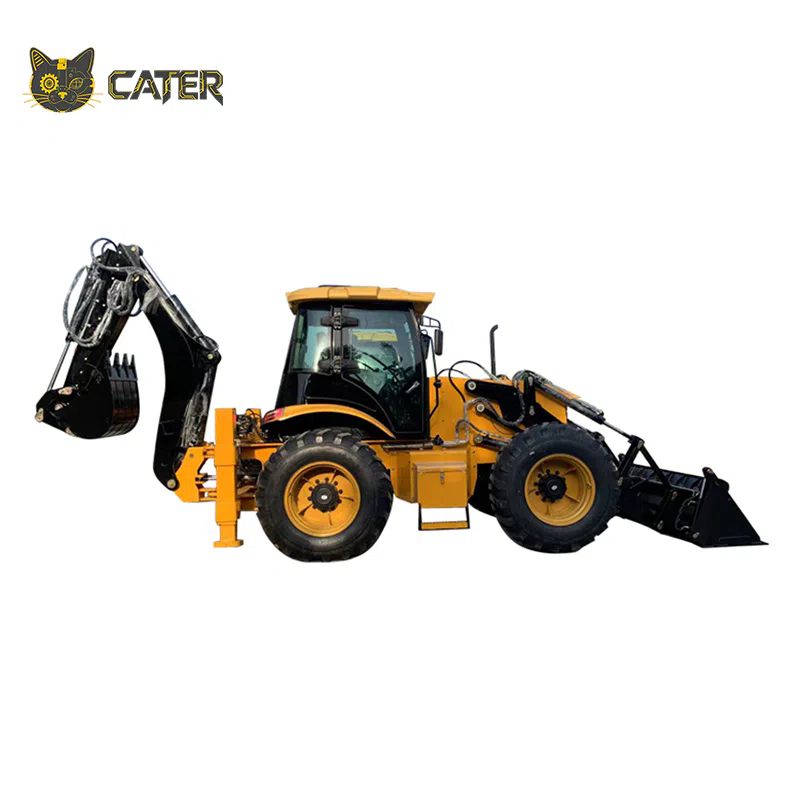
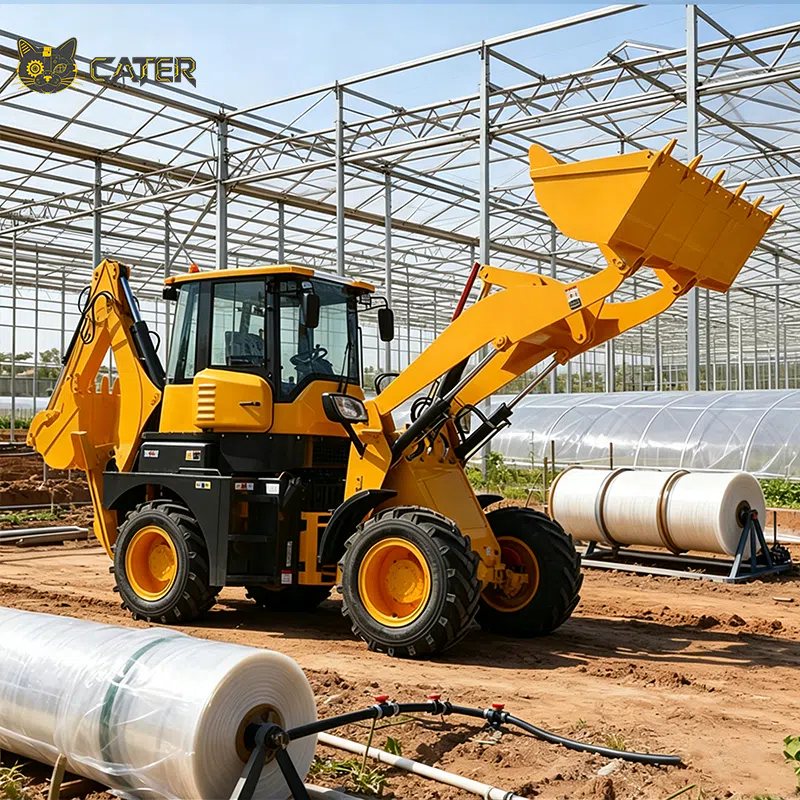
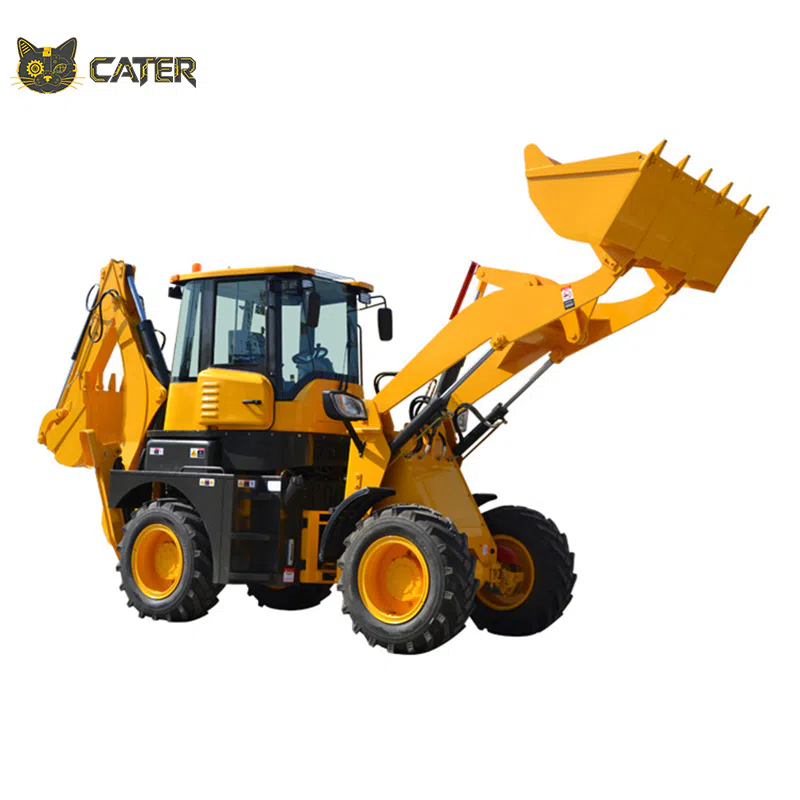
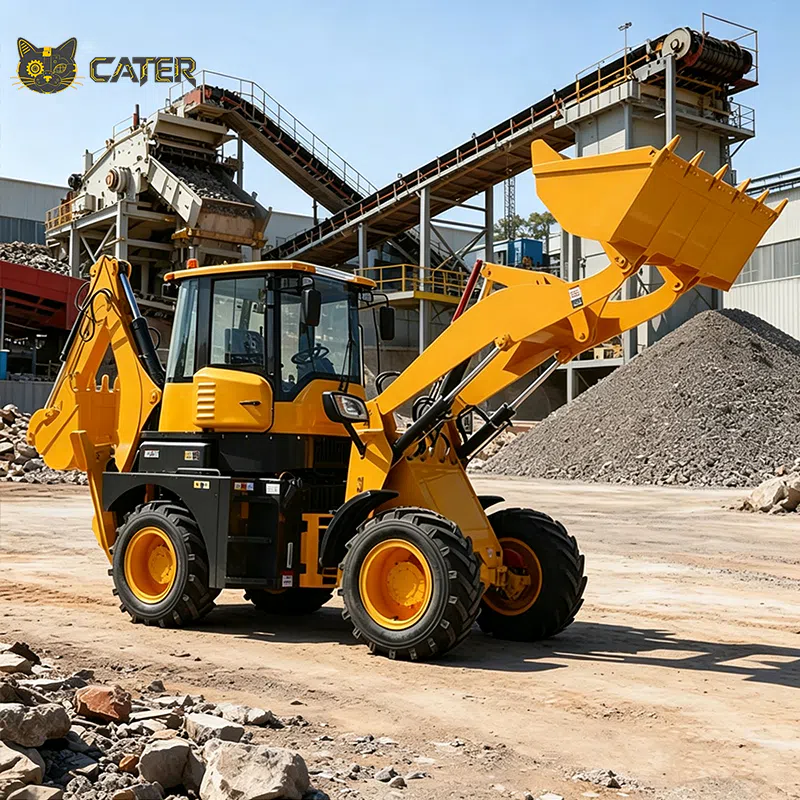
Reference values must be read against the machine they actually describe. The CATER product page for its wheel backhoe loader lists a 3.0 T rated load, a 9,000 kg machine weight, power published as 91 kW / 124 HP, a 1.5 m³ front bucket, a 0.38 m³ digger capacity, a 4,100 mm dig depth and overall dimensions of 7.8 × 2.38 × 3.3 m. Those are the published figures for that listed configuration, and they should not be read as universal values across the product line; for any order, the governing specification is the one written into the signed configuration confirmation. Attachments follow the same logic. Quick hitch, grappler, log fork, pallet fork, hydraulic breaking hammer and ripper are offered as options, and each one requires a compatibility review against the specific machine and task.
The published envelope also frames where this class of machine works. With an overall length of 7.8 m and a width of 2.38 m, and published applications covering road construction, infrastructure, municipal work and land preparation, site access, turning space and working width are worth checking against the machine rather than assumed. A larger and more versatile unit is not automatically the better answer in every setting, and a smaller or more specialised machine may suit confined or highly repetitive work better. Machine class should be selected against the job rather than the other way round.
Energy and Logistics
Fuel supply, consumables and transport between sites all affect real availability, and they are easy to overlook during a specification discussion. For any powertrain, conventional or alternative, we would recommend mapping refuelling or charging arrangements in advance, along with how a machine gets to and between sites. Where a site depends on a particular fuel or a single access route, that constraint belongs in the specification rather than in a discovery made during mobilisation.
Resale and Remarketing Planning
Resale planning deserves a place in the purchase conversation rather than a footnote at disposal time. The practical questions are local ones: how widely the configuration is used in your market, how easily attachments can be moved on to another owner, and whether the specification is standard enough to interest a second buyer. Those questions do not require a forecast, and they are best answered before the order is placed rather than three years later.
Frequently Asked Questions
Is the global backhoe loader market growing?
Fortune Business Insights projects growth from USD 11.79 billion in 2026 to USD 24.30 billion by 2034 at a 9.46% compound annual rate. That is a forecast built on estimates rather than a record of orders, and we would read it as a direction of travel rather than a promise of returns.
Why can US financed volumes fall while the global forecast rises?
The two datasets cover different scopes. The financed figures track one financing database in the United States across the twelve months from May 2025 to April 2026, while the forecast covers global market value from 2026 to 2034. Lower financed volume in a mature market is compatible with rising global value driven by other regions, replacement demand and higher value per machine.
Can I order a hydrogen backhoe loader today?
JCB's May 2026 announcement concerns its own 3CX Hydrogen model, with a 55 kW hydrogen combustion engine and three 350 bar roof-mounted tanks, and it notes a requirement for refuelling supply. That announcement describes JCB's product. It is not a CATER offering, and the practical availability of any alternative powertrain depends on refuelling and service arrangements in the operating region.
What should I compare first when choosing a configuration?
Start with the dominant tasks on site and the published reference values for the machine you are considering, then confirm parts and service support, then check energy and transport logistics. We would recommend treating published specifications as the starting point for a written configuration confirmation rather than as the final answer.
Request a Configuration-Specific Quotation
CATER builds a diesel wheel backhoe loader in the traditional front-bucket, rear-digging format, and the 3-ton class backhoe loader product page is a practical place to compare published figures. If you are still weighing machine classes, the backhoe loader category covers the wider range. Suitability always depends on the job mix, ground conditions and support arrangements at your site. If you are planning a purchase for the 2026–2027 season, request a configuration-specific quotation with your operating conditions, preferred attachments and expected working environment, or reach the team through the contact page or by email at info@caterequipment.com.cn.